What Is LBMA Good Delivery? Accredited Gold Bars Explained

Dealers in Dubai and across the Gulf often describe a bar as "LBMA-accredited" or "from an LBMA refiner". It sounds reassuring, but what does it mean, who does the accrediting, and does it apply to the small bar you are about to buy?
This guide explains the Good Delivery list, the large bars that banks trade, how they relate to small retail bars, and why accreditation affects how easily, and at what price, you can sell a bar later.
What the LBMA is, and what "Good Delivery" means
The London Bullion Market Association (LBMA) is the trade body that sets standards for the London market, the world's largest wholesale market for gold and silver. Its name is also attached to the LBMA Gold Price, set in daily auctions and widely used as a global benchmark.
"Good Delivery" is the standard for large bars accepted in settlement in London. The LBMA publishes the Good Delivery List of refiners whose bars meet it. A large bar from a listed refiner that meets the specification can change hands between banks without being re-tested each time.
The Good Delivery bar
The bar you see in photos of central bank vaults is the classic Good Delivery bar. Its main requirements:
- Weight: between 350 and 430 troy ounces of fine gold, typically about 400 ounces, or roughly 12.4 kilograms.
- Purity: at least 995 parts per thousand.
- Marks: a serial number, the refiner's stamp, the fineness and the year of manufacture.
- Finish: a cast bar of set dimensions, free of cavities and obvious defects.
Silver has an equivalent standard, with bars of about 1,000 ounces at a fineness of at least 999.
A worked example: a bar weighing 400 ounces gross at 995.0 fineness contains 400 × 0.995 = 398 ounces of fine gold, about 12.38 kg, and it is priced on that fine content. At a hypothetical 4,000 US dollars an ounce, it is worth 398 × 4,000 = 1,592,000 dollars, or about 5.85 million dirhams at the 3.6725 peg. The actual price right now is 4,072.10 US dollars an ounce.
How a refiner gets on the list, and stays there
Accreditation is not a one-off certificate. A refiner applying to join must show a track record, sufficient output and financial strength, and its sample bars are tested by independent laboratories approved by the LBMA.
Listed refiners are re-checked periodically to confirm that their assaying stays accurate, and they must pass an annual independent audit under the LBMA's Responsible Gold Guidance, which looks at where their gold comes from. A refiner that falls short can be suspended or moved to the Former List.
For buyers, the key point is that bars made while a refiner was accredited generally remain acceptable even if it later leaves the list, one reason the year of manufacture is stamped on large bars. The list changes, so check the current version on the LBMA's official website.
Small bars from accredited refiners
Good Delivery is a wholesale standard for large bars; the LBMA does not certify individual small bars. But listed refiners also make small bars for private buyers, and those bars carry the refiner's name and reputation, which usually makes them easier to sell.
| Bar type | Weight | Usual fineness | Typical use |
|---|---|---|---|
| Good Delivery bar | About 400 oz (roughly 12.4 kg) | 995 or higher | Banks, central banks, wholesale trade |
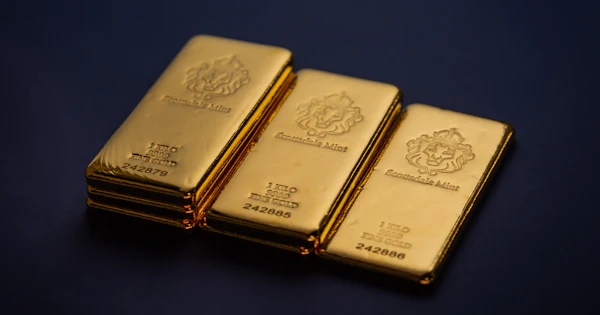
| Kilobar | 1,000 g (32.15 oz) | 999.9 | Traders and larger investors in Asia and the Gulf |
| 10-tola (TT) bar | 116.64 g | Usually 999 or higher | Savers in the Gulf and South Asia |
| 1-ounce bar | 31.10 g | 999.9 | Individual saving |
| Small bars | 1 to 100 g | 999.9 | Saving and gifts |
Small bars are either cast in moulds, with a rougher look, or minted from rolled strip, with a polished, often decorated face. Retail bars like these are 24K gold, and you can follow the live 24K gold price in dirhams. At the global spot price, a kilogram of 24K gold is worth about 480,807.59 dirhams right now; a kilobar sells for a small premium above that.
Serial numbers and assay certificates
Large bars always carry a unique serial number, as do many small bars from major refiners. The number should appear on your invoice, which helps trace the bar and prove ownership.
Many small minted bars come sealed in a tamper-evident card with an assay certificate showing the weight, fineness and serial number. Keep the card sealed and keep the original invoice: a dealer who sees intact packaging and a matching number can usually buy faster and test less.
A famous name is not a guarantee in itself, though; counterfeits of well-known brands exist. Buy from licensed dealers, and see our Dubai gold buying checklist for the basics.
Dubai's role as a gold hub
Dubai is one of the world's largest centres for physical gold trading, linking gold from Africa and elsewhere with buyers across Asia and the Middle East. The UAE is home to gold refineries and busy wholesale markets, alongside the famous Gold Souk in Deira.
Gulf shops therefore sell bars from internationally known refiners alongside bars from refiners in the region. Some regional refiners appear on international lists; others work to local standards only. Both may be readily accepted locally, but an internationally accredited bar is usually easier to sell abroad. For the supply chain behind a bar, see our guide on where gold comes from.
Why accreditation matters when you sell
- Speed: most dealers accept a bar from a known, accredited refiner after a quick check of weight, packaging and serial number.
- Price: a dealer may offer less for an unfamiliar bar, because they bear the cost of testing or re-refining it.
- Extra testing: an unknown bar may need an X-ray fluorescence (XRF) scan or a fire assay; the latter means taking a sample of the metal.
- Selling abroad: if you move country, an internationally recognised name makes selling easier.
- Tax: at the time of writing (2026), investment gold of 99% purity or more is zero-rated for VAT in the UAE under conditions set by the Federal Tax Authority; check its guidance for details.
This is general information, not investment advice, and buying and selling terms vary between dealers.
Frequently asked questions
Is every small bar from an accredited refiner a "Good Delivery bar"?
No. Good Delivery refers to large bars meeting the London specification, such as the 400-ounce bar. A small bar benefits from its maker's reputation but does not carry that status itself.
How can I check whether a refiner is on the list?
Look up the refiner's name, as stamped on the bar, in the list published on the LBMA's official website, and note the separate Former List of refiners that have left. If the name is not there, ask the dealer which standard the refiner follows.
Do accredited bars cost more?
Their premium over the global price may be slightly higher than for an unknown bar. Faster acceptance and a smaller discount when you sell can offset that, but this varies between dealers, so compare total premiums before you buy.
Accreditation does not change the gold itself, but it changes how far others trust it. Understanding it helps you choose a bar that will be easy to sell on the day you need to.