Where Does Gold Come From? From the Mine to the Bar
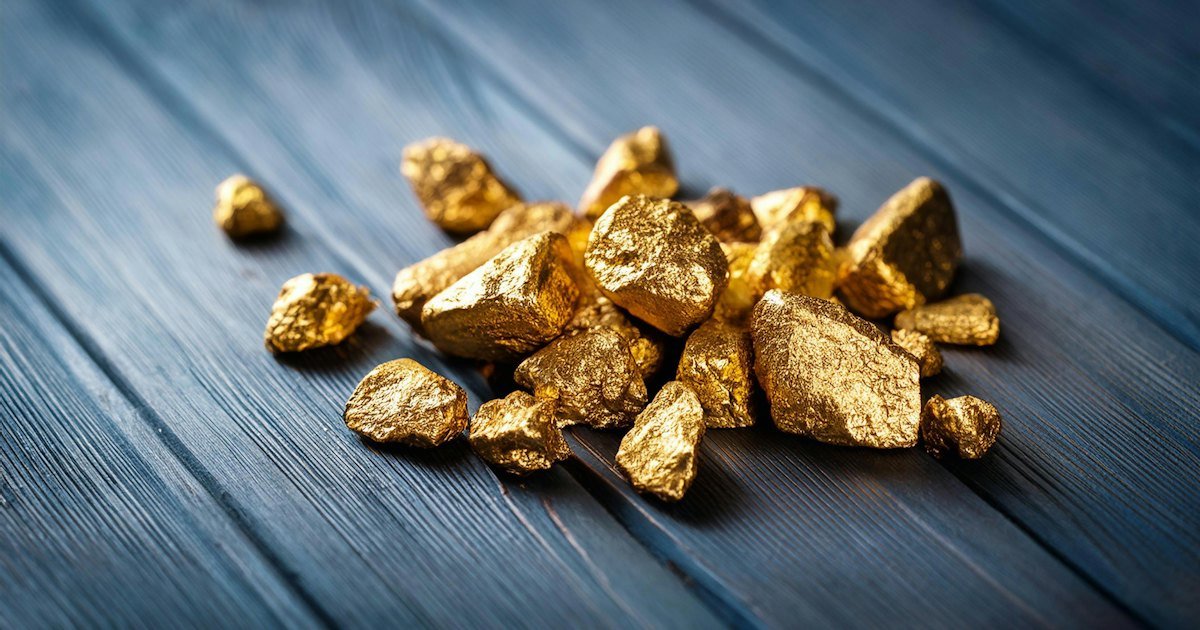
The bangle on your wrist or the bar in your safe probably began its journey in a mine thousands of kilometres away, and may have crossed several borders before reaching a shop in Dubai or Riyadh. That journey explains why gold is scarce and costly, and why the trade now cares so much about where it comes from.
This guide follows the journey step by step: geology, mining, refining, the leading producers, recycling, responsible sourcing and how much gold has ever been mined.
How gold forms and how it is found
Scientists believe gold atoms were forged in violent cosmic events, such as collisions between neutron stars, long before the Earth existed. Deposits worth mining formed much later inside the Earth's crust, when hot, mineral-rich fluids carried gold through cracks in the rock and left it in veins, often alongside quartz.
Over millions of years, erosion frees particles of gold from those rocks and water carries them away. Because gold is so dense, the particles settle in riverbeds and bends, forming placer, or alluvial, deposits.
Finding a deposit worth mining takes geological surveys, sampling and exploration drilling, and ten years or more can pass between discovery and first production. Grades are strikingly low: in many modern mines a tonne of ore holds only a few grams of gold, sometimes less than one.
The three main ways gold is mined
Open-pit mining
Used when a deposit is large, near the surface and low in grade. Miners dig a vast terraced pit, and giant trucks haul millions of tonnes of rock a year. The scale makes low-grade ore pay, but it reshapes the landscape.
Underground mining
When richer veins lie deep below ground, miners sink shafts and drive tunnels to reach them. Some South African gold mines go deeper than 3 kilometres, where the rock is so hot that tunnels need constant cooling and ventilation. Costs are higher, so the ore must be richer.
Alluvial (placer) mining
The oldest method: washing river sand and gravel to separate the heavy gold, using pans, sluices or dredges. The California gold rush of the mid-19th century began this way. Today millions of people work in small-scale or artisanal mining, much of it informal, and part of this sector still uses mercury, which harms health and the environment.
From ore to refined bar
- Crushing and grinding: ore is milled to a fine powder to free the gold.
- Extraction: coarse gold is separated by gravity; fine gold is usually dissolved in dilute cyanide, in tanks or on lined heaps, and captured on activated carbon.
- Smelting: the gold is melted into rough doré bars, a mix of gold, silver and other metals in varying proportions.
- Refining: refineries raise purity to 99.5% or 99.99% by chemical or electrolytic processes, separating out silver and other metals.
- Casting: pure gold is cast into large bars for international markets, or small bars and grain for jewellers and savers, stamped with the purity and the refiner's mark.
How much rock sits behind a familiar bar? For illustration, assume an ore grade of 1 gram per tonne and 90% recovery:
| Item | Gold content | Ore needed at 1 g/t | At 5 g/t |
|---|---|---|---|
| One tola | 11.66 g | About 13 tonnes | About 2.6 tonnes |
| 10-tola bar | 116.64 g | About 130 tonnes | About 26 tonnes |
| Kilobar | 1,000 g | About 1,111 tonnes | About 222 tonnes |
The formula is gold weight ÷ (grade × 0.9), which is why mines move such vast quantities of rock and why grade matters so much underground. For a sense of value, one tola of 24K gold costs about 5,608.05 dirhams in the UAE right now.
Where most of the world's gold is mined
Mines produce roughly 3,600 tonnes of gold a year, according to recent World Gold Council estimates. China, Russia and Australia are usually among the largest producers, followed by countries such as Canada and the United States, while Ghana leads Africa's producers. South Africa was the world's biggest producer for most of the 20th century, but its output has fallen sharply as its mines have aged and deepened.
A significant share of gold also comes as a by-product of copper mining, so some mines depend on both metals; you can follow live copper prices too. Closer to home, Saudi Arabia has a long mining history: Mahd adh Dhahab, whose name means "cradle of gold", was worked in ancient times and revived in the modern era.
The UAE is not a mining country, but it is one of the world's leading centres for refining and trading gold, so gold bought in Dubai may have been mined in Africa, South America or Asia and refined in the UAE, Switzerland or elsewhere.
Recycling: about a quarter of supply
Gold does not corrode or get used up, so it can be melted and refined again and again. Industry estimates put recycled gold at around a quarter of annual supply in recent years, roughly 1,100 to 1,400 tonnes a year.
Most of it is old jewellery sold by its owners, with a smaller share from electronics and industry, and volumes usually rise when prices climb or times are hard. An old piece you sell to a gold shop will very likely be melted down and return in a new form; before selling, our gold profit calculator shows how its current value compares with what you paid.
Responsible sourcing: why origin matters
Because gold is valuable and easy to move, in some regions it has funded armed conflict or money laundering, and it can be linked to child labour and mercury pollution. International frameworks therefore expect refiners and traders to check its origin, notably the OECD's due-diligence guidance for mineral supply chains and the Responsible Gold Guidance that the London Bullion Market Association (LBMA) applies to its accredited refiners.
Those refiners face independent audits every year and must report on their due diligence. In the UAE, authorities including the Dubai Multi Commodities Centre (DMCC) have issued due-diligence rules for the gold trade. Our guide to LBMA Good Delivery and accredited bars explains what accreditation involves.
As a buyer, your simplest safeguard is to buy bars from well-known accredited refiners through licensed dealers who issue a clear invoice.
How much gold has ever been mined?
The World Gold Council estimates that all the gold ever mined comes to more than 200,000 tonnes, about 216,000 tonnes by the end of 2024. Gold is so dense that it would all fit into a cube roughly 22 metres on each side. Around two-thirds of it has been mined since 1950.
Because gold lasts, nearly all of it still exists in some form. Its rough distribution, by commonly cited estimates:
- Jewellery: about 45%, including the bangles and necklaces kept in Gulf homes.
- Bars, coins and gold investment funds: about 22%.
- Central bank reserves: about 17%.
- Other uses, including industry, and unaccounted gold: about 15%.
Frequently asked questions
Could the world run out of gold?
Gold above ground does not disappear, and some returns to market through recycling. Large new deposits are harder to find and ore grades are falling at many mines, but output remains near historically high levels.
Is recycled gold different from newly mined gold?
Not in quality. Once refined, recycled gold has the same purity and is chemically identical to mined gold. The difference lies in its origin and footprint, as recycling generally uses far less energy than mining.
Do Gulf countries produce gold?
Saudi Arabia has a gold-mining sector and well-known historic sites, but the region's output is small compared with the major producers. The UAE, and Dubai in particular, stands out as a refining and trading hub rather than a mining country.
Every gram of gold you own stands for tonnes of rock, years of work and a long chain of hands. Knowing that journey puts you in a better position to ask where your gold came from.